Crypto holders should treat custody, regulation and altcoin dilution as the three biggest risks in 2026
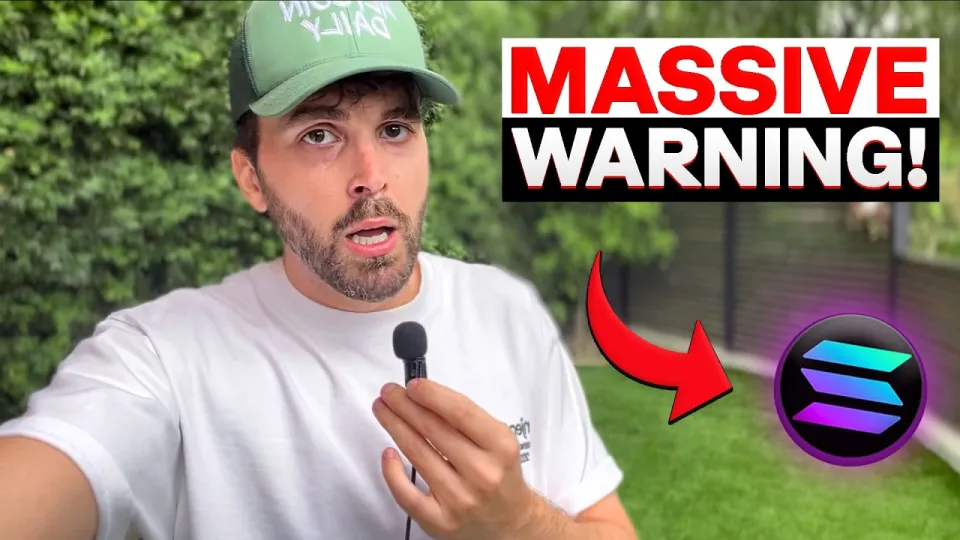
Video: My MASSIVE Warning To Crypto Holders
Want articles like this for your own video to promote it on YouTube and Google? Order them through the Telegram bot @sat_sit_bot. It writes articles around your video, embeds the video and publishes them on popular niche websites (no ads). Your first 50 articles are free.
· based on the channel Altcoin Daily
Key takeaways
- Altcoin Daily frames the warning around holders, not traders: the danger is what you do with coins you plan to keep.
- Custody risk is the one risk you can eliminate yourself by moving long-term holdings to self-custody.
- Regulation risk hits tokens whose value depends on a company's licence, not on a decentralised network.
- Stablecoin lending yields of 7% and similar rates carry issuer and platform risk, not free income.
- Position sizing matters more than picking the next breakout coin: size positions so a 50% drawdown does not force a sale.
Crypto holders face three risks worth acting on: where the coins are stored, how exposed the portfolio is to regulation, and how much of the portfolio sits in tokens that can be diluted or delisted. The practical answer is to move long-term holdings into self-custody, keep most capital in assets that do not depend on a single company's licence, and size positions so a deep drawdown never forces a sale. The warning in Altcoin Daily's breakdown is aimed at holders rather than traders, and it pairs with promotional offers such as a Weex registration bonus for new accounts that should be evaluated as a product, not as a reason to take extra risk.
The distinction matters because a trader can exit in seconds, while a holder is exposed to everything that happens between purchases: an exchange freezing withdrawals, a regulator reclassifying a token, a foundation unlocking supply. Each of those events is survivable with planning and destructive without it.
What the crypto warning for holders actually covers
The core message is that the biggest threat to a long-term crypto portfolio is not a bad entry price but an unmanaged structural exposure. Altcoin Daily's host walks through the categories of risk that holders tend to ignore because they are boring: counterparty risk on exchanges, the assumption that regulation only affects bad actors, and the belief that holding more coins equals holding more upside.
A useful way to sort any holding is to ask what has to go right for it to keep its value. If the answer is "the company stays licensed and solvent", that is a different bet from "the network keeps producing blocks". Both can work, but they belong in different sizes in a portfolio, and they need different exit rules.
Custody comes first: exchange risk versus self-custody
Custody is the only major risk a holder can remove completely, and the removal takes an afternoon. Coins left on a trading platform are an unsecured claim on that platform; coins in a hardware wallet are an asset you control with a seed phrase.
- Move the portion of the portfolio you do not plan to trade within the next 12 months to a hardware wallet.
- Write the seed phrase on paper or metal, store it offline, and never photograph it or type it into a website.
- Keep only working capital on exchanges, sized to what you would accept losing entirely.
- Test the recovery process once with a small amount before moving the full balance.
- Split large balances across two devices so a single hardware failure is not a crisis.
Viewers repeatedly ask whether mainstream brokerage-style apps are safe for crypto. The honest answer is that any platform holding your keys is a counterparty, whether it is a crypto-native exchange or a stock brokerage offering crypto. The brand does not change the structure of the risk; only self-custody does.
Regulation risk is not the same for every token
Regulation risk is concentrated in assets whose value depends on a specific company's licence, banking partner or legal classification. A token issued by a centralised entity that needs permission to operate in major markets carries a different risk profile from a decentralised network that keeps producing blocks regardless of who is allowed to list it.
This is why holders should separate the question "is this a good project?" from "who has to stay compliant for this to keep working?". Stablecoin issuers, custodial yield products and tokenised fund structures all sit in the second category. When rules shift, the token does not have to fail technically to lose value; it only has to become harder to hold, trade or redeem.
The practical response is not to avoid regulated assets entirely but to cap them. A common approach is to keep the regulated or company-dependent sleeve of a portfolio small enough that a single adverse decision does not change your financial plan.
The stablecoin yield question holders keep asking
Stablecoin lending rates in the high single digits look like free money next to a savings account, and that is exactly why they deserve scrutiny. A 7% yield on a dollar-pegged asset is a return for taking on issuer risk, platform risk and smart-contract risk, and the holder is paid for accepting all three.
Before depositing, check four things: who issues the stablecoin and what backs it, whether the platform lends your balance out or holds it, what happens to withdrawals during stress, and whether the yield is paid in the same asset or in a token. If any of those answers is unclear, the yield is not comparable to a bank rate.
Altcoin dilution and the cost of holding too many positions
Every additional position adds monitoring work and dilution risk. Tokens with ongoing emissions, foundation unlocks or treasury sales have a structural headwind that holders often underestimate: the supply grows while their balance stays flat.
A workable rule is to hold a small number of positions you can actually follow, and to know the unlock schedule for each one. If a token has a large unlock in the next two quarters, that is a fact to price in before buying, not after. The same logic applies to coins that depend on a single exchange listing or a single partnership announcement.
Questions holders raise about the warning
Several recurring concerns come up around this topic, and they are worth answering directly rather than dismissing. Holders want to know whether the warning means selling, whether mainstream apps are disqualified, whether lending products should be avoided entirely, and whether a small portfolio is even worth the effort.
The short version: the warning is about structure, not about price targets. It does not require selling everything, it does not single out one brand, and it does not forbid yield products — it asks you to know what you own and why. A small portfolio benefits from the same discipline as a large one, because the cost of a mistake is proportionally identical.
All links from the video
- Weex welcome event with a deposit bonus for new accounts: https://www.weex.com/events/welcome-event?vipCode=oz5p&qrType=activity
- Bitunix registration link promoted in the video: https://www.bitunix.com/register?vipCode=AltcoinDaily
The bottom line for crypto holders
Custody, regulation and position size decide whether a holder survives a bad year, and all three are controllable without predicting the market. Altcoin Daily's warning is a reminder that the risk in a long-term crypto portfolio is usually structural rather than directional. Start with the coins you cannot afford to lose and move them off exchanges, then cap the part of the portfolio that depends on a company staying licensed. If you open a new account to act on any of this, use the Weex bonus page and treat the bonus as a small offset to fees, never as a reason to increase your exposure.
Source: My MASSIVE Warning To Crypto Holders · Markdown version
Questions & answers
Does this warning mean crypto holders should sell their coins?
No. The warning targets structure rather than price: where coins are stored, how much depends on a single company's licence, and how large each position is. A holder can act on all three without selling a single coin. Selling is only one option, and usually the last one worth taking.
Are mainstream brokerage apps unsafe for holding crypto?
They are not automatically unsafe, but they work differently from self-custody: you hold a claim on the platform rather than the keys. That is acceptable for amounts you are willing to leave with a counterparty. For long-term holdings, a hardware wallet removes that exposure entirely.
Is a 7% yield on stablecoins worth the risk?
It depends on what backs the stablecoin, how the platform generates the yield, and how easily you can withdraw during stress. High single-digit rates are compensation for issuer, platform and contract risk. If you cannot explain where the yield comes from, size the deposit as a risk position, not as cash.
How many coins should a holder keep in a portfolio?
Enough to diversify, few enough to monitor unlock schedules and news for each one. Every added position increases dilution risk and research time. Many holders find that a handful of well-understood assets plus a small speculative sleeve is easier to manage than a long list.